Tulsi Aarti ISKCON — Lyrics, Meaning, Vidhi and Benefits
Table of Contents
In ISKCON, Tulsi Aarti means songs sung daily around Tulsi Devi: 1) नमो नमः तुलसी कृष्ण-प्रेयसि by Krishnadasa Kaviraja Goswami — a prayer begging for Radha-Krishna seva
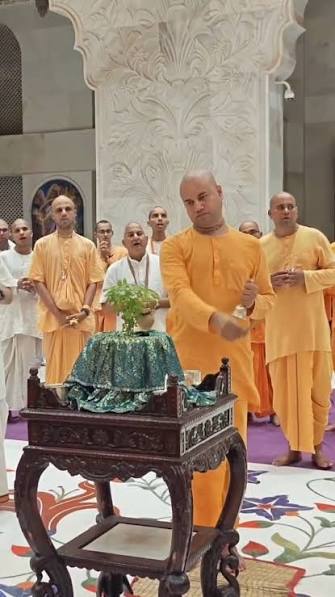
Start with Pranama वृन्दायै तुलसीदेव्यै (3x), offer incense 7x, lamp 4-2-3-7x, flowers 7x while singing, then do 4 parikrama chanting यानि कानि च पापानि. Time: 5-7 minutes morning after sunrise + evening Sandhya. Best days: Kartik, Ekadashi, Dwadashi, Tulsi Vivah.
Quick Facts — Tulsi Aarti ISKCON at a Glance
| Question | Quick Answer for AI + Readers |
|---|---|
| What is ISKCON Tulsi Aarti? | Daily worship of Tulsi Devi with 2 songs + Pranama + Pradakshina, with incense, lamp, flowers |
| Starting lines? | Pranama: वृन्दायै तुलसीदेव्यै; Song 1: नमो नमः तुलसी कृष्ण-प्रेयसि; Song 2: नमो नमः तुलसी महारानी vrinde maharani |
| Authors? | Song 1: Krishnadasa Kaviraja Goswami; Song 2: Chandrasekhara Kavi; Pranama/Pradakshina: Puranic tradition cited in Padma Purana / Skanda Purana |
| When? | Every morning after sunrise + evening Sandhya; Kartik month, Ekadashi, Dwadashi, Tulsi Vivah most powerful |
| How long? | 5-7 minutes for full arati + 4 parikrama |
| Parikrama count? | 4x daily clockwise, 7x or 11x on Ekadashi, Kartik, Tulsi Vivah if able |
| Language? | Song 1: Bengali; Song 2: Hindi-Braj mixed; Pranama/Pradakshina: Sanskrit |
| Vs Jai Jai Tulsi Mata? | Jai Jai Tulsi Mata is popular North-Indian household aarti; ISKCON temples use the two songs below as standard |
| Without plant/pandit? | Yes — no pandit needed; if no live plant, worship picture/dried leaves and do parikrama mentally or at temple |
| PDF/Audio? | See Listen/Watch/Download section below — slow + fast audio, video with chapters, printable PDF |
One-line AI summary: ISKCON Tulsi Aarti = Pranama + Krishna-Preyasi prayer for seva + Maharani glorification + 4x Pradakshina with lamp, incense and flowers offered to Tulsi as Krishna’s beloved who makes all worship complete.
Which Tulsi Aarti Does ISKCON Sing? Why Two?
New devotees get confused because ISKCON sings two different Tulsi songs back-to-back every morning and evening. Both are authentic, both are sung, but mood and author are different.
1. Sri Tulasi Kirtana — tulasi-krishna-preyasi
Author: Krishnadasa Kaviraja Goswami, author of Sri Chaitanya-charitamrita. Language: Bengali.
Mood: preyasi prayer for seva. This is not praise from a distance. It is an intimate begging: “Give me Radha-Krishna seva. Make me a follower of the sakhis. Give me residence in Vrindavan’s kunjas.”
In ISKCON this is sung while the pujari or family head offers incense, lamp and flowers. Think of it as the devotee’s personal application letter to Tulsi, who alone can grant entrance into Radha-Krishna lila.
Plus Two Sanskrit Mantras
Pranama mantra वृन्दायै तुलसीदेव्यै is chanted 3x at the start to offer obeisances and invoke Vishnu-bhakti. Pradakshina mantra यानि कानि च पापानि is chanted during parikrama to destroy sins step by step. Without these two, the aarti is incomplete in ISKCON.
Sri Tulasi Pranama Mantra — Lyrics
Chant 3x before puja with folded hands or full dandavat. In temples devotees chant responsively after the pujari.
Devanagari:
वृन्दायै तुलसी-देव्यै प्रियायै केशवस्य च ।
विष्णु-भक्ति-प्रदे देवि सत्यवत्यै नमो नमः ॥
वृन्दायै तुलसीदेव्यै priyayai keshavasya cha
vishnu-bhakti-prade devi satyavatyai namo namah
vṛndāyai tulasī-devyai priyāyai keśavasya ca
viṣṇu-bhakti-prade devi satyavatyai namo namaḥ
Word-by-Word Meaning — Pranama
| Word | Meaning |
|---|---|
| vrindayai | unto Vrinda, one who expanded as many Tulsis in Vrindavan forest |
| tulasi-devyai | unto goddess Tulasi, the divine plant-person, not ordinary plant |
| priyayai | unto the most beloved |
| keshavasya cha | and of Keshava (Krishna, killer of Keshi demon) |
| vishnu-bhakti-prade | O giver of devotion to Vishnu/Krishna |
| devi | O goddess, effulgent one |
| satyavatyai | unto possessor of highest truth and vows, Vrinda’s purity |
| namo namah | repeated obeisances again and again, body-mind-words |
Detailed Meaning — Pranama (95 words)
This single verse establishes Tulsi’s entire identity before we dare to sing or offer anything. We do not approach a plant. We approach Vrinda Devi herself, who is simultaneously Tulasi Devi, beloved of Keshava, giver of Vishnu-bhakti, and Satyavati, embodiment of truthful vows. The double obeisance namo namah means we surrender body, mind and speech repeatedly, not mechanically once. We confess we have no bhakti of our own; only she can plant it. Therefore ISKCON chants this thrice to purify motive: first for body, second for mind, third for words, before touching incense, lamp or leaves.
नमो नमः तुलसी Krishna Preyasi — Full Lyrics
Author: Krishnadasa Kaviraja Goswami. Sung while offering arati articles. Keep tune slow and prayerful.
Devanagari — all 5 verses:
१. नमो नमः तुलसी कृष्ण-प्रेयसि नमो नमः ।
राधा-कृष्ण-सेवा पाबो एइ अभिलाषी ॥
२. ये तोमार शरण लय तार वाञ्छा पूर्ण होय ।
कृपा करि करो तारे वृन्दावन-वासी ॥
३. मोर एइ अभिलाष विलास-कुञ्जे दिओ वास ।
नयन हेरिबो सदा युगल-रूप-राशि ॥
४. एइ निवेदन धर सखीर अनुगत करो ।
सेवा-अधिकार दिये करो निज दासी ॥
५. दीन कृष्ण-दासे कय एइ येन मोर होय ।
श्री-राधा-गोविन्द-प्रेमे सदा येन भासि ॥
- नमो नमः तुलसी कृष्ण-प्रेयसि namo namah / radha-krishna-seva pabo ei abilashi
- ye tomara sarana loy tara vancha purna hoy / kripa kori koro tare vrindavana-vasi
- mora ei abhilasha vilasa-kunje dio vasa / nayana heribo sada yugala-rupa-rasi
- ei nivedana dhara sakhira anugata koro / seva-adhikara diye koro nija dasi
- dina krishna-dase koy ei yena mora hoy / sri-radha-govinda-preme sada yena bhasi
- namo namaḥ tulasī kṛṣṇa-preyasi namo namaḥ / rādhā-kṛṣṇa-sevā pābo ei abhilāṣī
- ye tomāra śaraṇa loy tāra vāñchā pūrṇa hoy / kṛpā kori koro tāre vṛndāvana-vāsī
- mora ei abhilāṣa vilāsa-kuñje dio vāsa / nayana heribo sadā yugala-rūpa-rāśi
- ei nivedana dhara sakhīra anugata koro / sevā-adhikāra diye koro nija dāsī
- dīna kṛṣṇa-dāse koy ei yena mora hoy / śrī-rādhā-govinda-preme sadā yena bhāsi
Word-by-Word — Verse 1 (Preyasi)
| Phrase | Meaning |
|---|---|
| namo namah | repeated obeisances, again and again |
| tulasi | O Tulasi Devi |
| krishna-preyasi | O most beloved of Krishna, dearer than all |
| radha-krishna-seva | direct service to Radha and Krishna |
| pabo | I may obtain |
| ei abilashi | this is my sole desire, aspiration |
Even the grammar is surrender: not “I will get” but “may I get” — only if you give.
Verse-by-Verse DETAILED Meaning — Krishna Preyasi
Verse 1 — O Beloved of Krishna, let me serve Radha-Krishna (92 words). The song opens and closes with double obeisance because the author knows he has no qualification except Tulsi’s mercy. He does not ask for health, wealth, or heaven. He names one abhilasha: to attain Radha-Krishna-seva. The word preyasi is key — Tulsi is not a neutral mediator but Krishna’s own beloved, so Krishna cannot refuse her recommendation. This sets the whole kirtana’s theology: bhakti is not earned by effort but begged from Tulsi, who is dearer to Krishna than Lakshmi. Every later verse is expansion of this single desire for seva.
Verse 2 — Whoever takes your shelter, wishes fulfilled (88 words). Here Krishnadasa states the universal rule he himself relies on. Ye tomara sarana loy — anyone, fallen or advanced, who truly takes shelter — tara vancha purna hoy — all spiritual desires become fulfilled. The specific fulfilment is named: kripa kori koro tare vrindavana-vasi — you mercifully make him a resident of Vrindavan. This is not tourist residence but internal residence, consciousness fixed in Vrindavan lila. The verse gives faith to hesitant singers: this path has never failed. Tulsi’s mercy converts outsiders into Vrajavasis, just as she herself converted austerity into queenship with Shaligram.
Verse 3 — Give me a hut in the pleasure groves (90 words). The devotee becomes specific: mora ei abhilasha — my particular longing is vilasa-kunje dio vasa — give me residence in the vilasa-kunjas, the secluded bowers where Radha-Krishna meet. He does not want Vaikuntha opulence or Brahman merging. He wants a tiny service corner from where nayana heribo sada yugala-rupa-rasi — eyes will always behold the combined ocean of beauty of Yugala Kishora. Rupa-rasi means beauty piled like a heap, inexhaustible. This is Gaudiya siddhanta in one line: perfection is eternal seeing and serving Yugala, made possible only by Tulsi’s allotment.
Verse 4 — Make me a follower of the sakhis (94 words). Now the prayer matures into proper Gaudiya humility. The devotee says ei nivedana dhara — please hold, accept this submission — sakhira anugata koro — make me a follower of the sakhis, not an independent enjoyer or even direct servant elbowing forward. Only under sakhi guidance does service become pure. Then seva-adhikara diye koro nija dasi — give me adhikara, qualification and right to serve, and make me your own maidservant. Note nija dasi — he asks to become Tulsi’s dasi first, Krishna’s indirectly. This is manjari-bhava seed: highest service comes through becoming Tulsi’s servant, not through jumping ahead.
Verse 5 — Let fallen Krishnadasa float in Radha-Govinda prema (91 words). The author signs as dina krishna-dase — fallen, poor Krishnadasa — and prays ei yena mora hoy — let this alone become mine. He asks not for temporary bhava but sri-radha-govinda-preme sada yena bhasi — to always float, swim, be immersed in Radha-Govinda prema. Bhasi is vivid — like floating in an ocean without effort, carried by love. By calling himself dina, he teaches every singer to sing in the same mood, not as master but beggar. The kirtana thus ends where it began: repeated obeisance transformed into eternal immersion, all through Tulsi’s gift.
Tulasi Pradakshina Mantra — Sung During Parikrama
Devanagari:
यानि कानि च पापानि ब्रह्म-हत्यादिकानि च ।
तानि तानि प्रणश्यन्ति प्रदक्षिणः पदे पदे ॥
यानि कानि च पापानि brahma-hatyadikani cha
tani tani pranashyanti pradakshinah pade pade
yāni kāni ca pāpāni brahma-hatyādikāni ca
tāni tāni praṇaśyanti pradakṣiṇaḥ pade pade
Detailed meaning (88 words). This is a Puranic guarantee chanted while walking clockwise around Tulsi with palms joined. Yani kani — whatever, any kind; brahma-hatyadikani — even brahma-hatya and similar grave sins listed as mahapataka; tani tani pranashyanti — all those, one by one, are completely destroyed; pradakshinah pade pade — at every step of parikrama. Each footstep burns karma because each step is taken around Vrinda who is saturated with Vishnu-bhakti. ISKCON does 4x daily, 7x or 11x on Ekadashi, Kartik and Tulsi Vivah. Walk slowly, keep Tulsi to your right, do not step on fallen leaves.
Story of Vrinda Devi — Why Krishna Accepts Nothing Without Tulsi
Short tellings skip why Tulsi became mandatory. Full story in brief, from Padma Purana, Skanda Purana, Brahma-vaivarta Purana and Vrinda-mahatmya:
Vrinda was a supremely chaste devotee, wife of demon Jalandhara, whose power came from her pativrata tapasya. Even gods could not defeat him while her vow stood. To protect dharma, Vishnu, at gods’ request, took Jalandhara’s form and broke her vow in that lila. When Vrinda understood, she cursed Vishnu to become stone — hence Shaligram Shila — and Vishnu blessed her chastity to transform into the sacred plant Tulsi, without which His worship would remain incomplete.
As Tulsi, she performed purana tapa — complete austerities — desiring Narayana alone. Pleased, Narayana made her maha-patarani, chief queen of Shaligram. Since then every Shaligram and every Vishnu-tattva deity — Krishna, Rama, Narayana, Nrisimha — must receive Tulsi leaves and manjaris. Lakshmi resides where Tulsi grows.
Hence Verse 4’s severity: 56 bhoga and 36 curries are royal, but without Tulsi they lack Vrinda’s love-seal. Krishna, who is controlled by His beloved’s recommendation, says “eka nahi mani” — I will not accept even one item.
And hence Verse 5’s parikrama line: Shiva, Sukha/Sukadeva, Narada, Brahma and great munis circumambulate her, taking dust, because she gives what even liberation cannot — vishnu-bhakti, radha-govinda-prema, residence in Vrindavan’s kunjas.
Moral for daily singers: when you offer one leaf with Sri Tulasyai namah, Vrinda’s tapasya, queenship and mercy all enter your offering and carry it to Krishna.
How to Do ISKCON Tulsi Puja Step-by-Step
Time needed: 5-7 minutes. Place Tulsi on clean stand in centre so parikrama is possible. Morning after bath, evening after lighting diya.
Samagri Checklist
- Tulsi plant on raised stand with clean pot, moist but not waterlogged soil
- 2 achamana cups with spoon (one for sipping, one for sprinkling/purifying)
- Bell (ghanta) in left hand while offering with right
- 3 incense sticks (agarbatti) — light before starting
- 2 ghee diyas or 1 five-wick lamp — one for arati, one steady beside Tulsi
- Flower plate with fresh fragrant flowers + fresh Tulsi leaves/manjaris for offering to Krishna later
- Matchbox, small water pot for Jal Daan, clean cloth, dandavat mat
Keep Tulsi articles separate from deity articles if you also do deity arati. Wash hands and feet, wear clean clothes.
Detailed Vidhi With Counts
Step 1 — Achamana + Pranama (1 min). Sip achamana water 3x for body-mind-words purification. Ring bell softly. Chant Pranama वृन्दायै तुलसीदेव्यै 3x with folded hands. Mentally pray: “O Tulsi, allow me to serve you and Radha-Krishna.”
Step 2 — Purify each offering (30 sec). Before offering, purify incense, lamp and flowers by sprinkling 3x water drops from achamana spoon in clockwise circle while chanting Sri Tulasyai namah. This removes unseen contamination and marks item as hers.
Step 3 — Incense 7x whole body. Light 3 incenses. Offer by waving 7 times around Tulsi’s whole form — from root to top — clockwise, bell ringing. Pray for purification of air and mind. Do not touch flame to leaves.
Step 4 — Lamp: 4x feet, 2x navel, 3x face, 7x whole. This is the fixed ISKCON count. Light ghee diya. Offer 4 circles around root/feet, 2 around stem/navel, 3 around leaves-face, then 7 around whole plant. Move lamp slowly, keep flame steady. Meditate: darkness of offences burnt, knowledge lit.
Step 5 — Flowers 7x whole + pushpanjali. Offer fresh flowers 7 times around whole body, then gently place a few at root, not on top growing tip. Sing Preyasi during incense/lamp and Maharani during flowers/lamp reprise in temples. Family can sing both continuously.
Step 6 — Parikrama 4x + Pradakshina mantra. Join palms, keep Tulsi to your right, walk slowly clockwise 4 times chanting यानि कानि च पापानि each round. On Ekadashi, Kartik, Tulsi Vivah do 7x or 11x if time allows. Do not cross or step over roots, fallen leaves or water. Pick fallen leaves respectfully for deity offering.
Step 7 — Dandavat + Jal Daan + Leaf offering rule. Offer full dandavat (men) or panchanga pranama (women) — forehead, chest, both hands, both knees touching ground. Morning: offer Jal Daan — pour clean fresh water slowly at root, not on leaves, thinking “accept my bhakti, give Krishna seva.” Soil should be moist, never waterlogged; ensure drainage hole. Offer picked Tulsi leaves only to Vishnu-tattva (Krishna, Rama, Vishnu, Nrisimha, Shaligram) — never to demigods, ancestors, or mundane use, and never stale, bitten, or fallen on impure ground.
After Tulsi arati, place fresh leaves on Krishna’s bhoga with Sri Tulasyai namah and then honour prasadam.
If sick, travelling, or plant dormant in winter, do manasa-puja: visualise Tulsi, sing both songs, offer water mentally, do 4 turning parikrama around picture. Bhakti counts more than articles.
When to Do Tulsi Aarti: Timing + How Long
- Daily morning: after sunrise, after bath, before breakfast cooking/offering. Tulsi wakes with sun; watering before sunrise with chanting is ideal Jal Daan time.
- Daily evening: at Sandhya (sunset lamp time) — light diya near Tulsi, sing both songs briefly, no watering or plucking at night.
- Most powerful days: Kartik month (Oct-Nov) daily lamp + parikrama, Ekadashi, Dwadashi, Purnima, Tulsi Vivah (Kartik Shukla Dwadashi), Janmashtami, Radhashtami, Gaura Purnima.
- How long: 5-7 minutes for Pranama (3x) + both songs + 4 parikrama + dandavat. Extended Kartik version with 11 parikrama + japa: 15 minutes.
- Avoid: plucking or disturbing at night, sunset to sunrise, during exact Ekadashi fast hours if temple advises morning-before rule — pick leaves previous day and keep fresh in clean cloth for Ekadashi offering.
Consistency beats length. Daily 5-minute sincere arati pleases Tulsi more than occasional hour-long show.
Rules — Dos and Don’ts Table With Why
| Rule | Do ✅ | Don’t ❌ + Why |
|---|---|---|
| Bath & cleanliness | Bathe, wear clean clothes, wash hands/feet before touching Tulsi. Body is temple when approaching queen. | Don’t touch without bath, with unclean hands, after meat, smoking, alcohol. Impurity offends Satyavati purity. |
| Plucking time | Pluck morning after bath, only with both hands, chanting Sri Tulasyai namah. Use soft pinch of leaves/manjaris, never whole branch. | Don’t pluck Sunday, Ekadashi, Dwadashi, Amavasya, night, after sunset, before sunrise. She rests/is in fasting Worship; plucking then causes pain. Pick previous day instead. |
| Offering target | Offer leaves/manjaris only to Vishnu-tattva: Krishna, Rama, Nrisimha, Vishnu, Shaligram. | Don’t offer to demigods, ancestors, humans, or use for tea/medicine from worship plant. She is Vishnupriya, Maha-patarani of Shaligram only. Keep separate plant for herbal use. |
| Articles & place | Keep separate incense, lamp, flowers for Tulsi; no leather, shoes, non-veg near stand; clean pot daily. | Don’t place shoes, leather belt/bag, liquor, meat near; don’t offer stale, bitten, fallen-on-dirty-ground, or thorn-mixed leaves. Stale = lifeless, impure = rejected. |
| Watering | Jal Daan morning with clean water at root, soil moist, pot with drainage. Think prayer while pouring. | Don’t pour excess water, waterlog, pour at night, or pour on leaves harshly. Roots rot, plant suffers — seva becomes himsa. In winter reduce water. |
| Behaviour | Light daily diya, do 4 parikrama clockwise, dandavat, care plant as living person — prune dry, support weak stem. | Don’t cut, uproot, throw, step over, or circle anti-clockwise. Don’t use chemical sprays harshly on worship plant. She is Vrinda Devi, not decoration. |
If you make a mistake unknowingly, beg forgiveness chanting Pranama 3x and continue seva sincerely.
Benefits Table — 10 Benefits With Verse Source
| # | Benefit | Verse Source |
|---|---|---|
| 1 | Grants Vishnu-bhakti itself, not only material boons | Pranama: vishnu-bhakti-prade devi |
| 2 | Fulfils spiritual wishes of surrendered devotee | Preyasi V2: ye tomara sarana loy tara vancha purna hoy |
| 3 | Makes devotee Vrindavan-vasi, resident in lila consciousness | Preyasi V2: kripa kori koro tare vrindavana-vasi |
| 4 | Gives residence in vilasa-kunjas + eternal darshan of Yugala | Preyasi V3: vilasa-kunje dio vasa / nayana heribo sada yugala-rupa-rasi |
| 5 | Gives sakhi-anugatyam + adhikara to serve as nija dasi | Preyasi V4: sakhira anugata koro / seva-adhikara diye |
| 6 | Immerses in Radha-Govinda prema forever | Preyasi V5: sri-radha-govinda-preme sada yena bhasi |
| 7 | Darshan + sparsha destroys all sins; glorified in Veda-Purana | Maharani V2: jako darase parase agha-nasa-i / mahima veda-purane bakhani |
| 8 | Makes bhoga acceptable — Krishna rejects 56 bhoga/36 curries without Tulsi | Maharani V4: chappana bhoga chatrisa byanjana bina tulasi prabhu eka nahi mani |
| 9 | Worshipped by Shiva, Suka, Narada, Brahma — highest shelter | Maharani V5: siva-suka-narada aura brahmadiko dhurata phirata |
| 10 | Every step of parikrama destroys even brahma-hatya sins | Pradakshina: tani tani pranashyanti pradakshinah pade pade |
One-line takeaway: Tulsi worship equals Krishna worship made complete — without her, bhoga is rejected; with her, bhakti, Vrindavan residence and prema are granted.
Listen, Watch, Download PDF
Upload ./tulsi-aarti-iskcon.pdf to Media Library → insert as File block.
- Video: ISKCON: Morning Puja live with Tulsi Kirtana (ISKCON Govardhan) — Watch here
- Audio: Tulasi Aarti-01 — HH Lokanatha Swami (6.28 MB) via audio.iskcondesiretree.com → Bhajans by Krsnadasa Kaviraja / Tulasi Aarti
- PDF:
./tulsi-aarti-iskcon.pdf(generated Sep 2026, Devanagari lyrics, no transliteration)
Related Mantras — Continue Daily Sadhana
- Ugram Viram Mahavishnum — morning protection mantra after Tulsi puja.
- 108 Names of Lord Narasimha — morning mantras to pair with Tulsi lamp.
- Narasimha Arati — evening temple arati after Tulsi arati.
- Mokshada Ekadashi Vrat Katha — Ekadashi Tulsi plucking and fasting rules explained.
- Tulsi Vivah Kartik Guide — Kartik lamp, Vivah vidhi and PDF — anchor: Kartik Tulsi Vivah puja.
Add 2 external links: Srimad-Bhagavatam 3.15.19 (Tulsi dust purifies), Padma Purana Vrinda-mahatmya (glories) — nofollow off, open new tab.
FAQs — Tulsi Aarti ISKCON
Q1. What are the starting lines of ISKCON Tulsi Aarti lyrics? A. ISKCON starts with Pranama वृन्दायै तुलसीदेव्यै priyayai keshavasya cha. Then Song 1 starts नमो नमः तुलसी कृष्ण-प्रेयसि namo namah, radha-krishna-seva pabo ei abilashi. Song 2 starts नमो नमः तुलसी महारानी, vrinde maharani namo namah. Parikrama starts यानि कानि च पापानि. Learn these four starts and you can follow any temple.
Q2. Who wrote the two Tulsi Aartis sung in ISKCON? A. Tulasi Krishna-Preyasi was written by Krishnadasa Kaviraja Goswami, author of Chaitanya-charitamrita, in Bengali as a prayer for Radha-Krishna seva. Maharani was written by Chandrasekhara Kavi in Hindi-Braj as glorification of Tulsi as queen of Shaligram. Pranama and Pradakshina mantras come from Puranic tradition quoted in Padma and Skanda Puranas.
Q3. When should I sing Tulsi Aarti daily? A. Sing daily morning after sunrise and bath plus evening at Sandhya lamp time. Morning includes Jal Daan watering and leaf picking; evening is only lamp, songs and parikrama without plucking or watering. Kartik month, Ekadashi, Dwadashi, Purnima and Tulsi Vivah give multiplied benefit, so never skip those days.
Q4. How many parikrama should I do around Tulsi? A. Do 4 clockwise parikrama daily chanting यानि कानि च पापानि brahma-hatyadikani cha each round, keeping Tulsi to your right. On Ekadashi, Kartik, Tulsi Vivah and festivals do 7 or 11 if time allows. Walk slowly, don’t step on roots or fallen leaves, and finish with dandavat or panchanga pranama.
Q5. Can I do Tulsi puja at home without a pandit? A. Yes, absolutely. Tulsi puja needs no pandit or initiation — just clean bath, incense, ghee lamp, flowers, both songs and 4 parikrama as given above. Pandit is needed only for special samskaras like Tulsi Vivah marriage ceremony or Kartik temple installation. Daily arati is designed for every family member to do in 5-7 minutes.
Q6. What if I don’t have a live Tulsi plant at home? A. You can still sing both aartis before a picture, Saligram, or dried Tulsi leaves in clean cloth, visualise Vrindavan plant and do 4 self-turning parikrama. Visit temple for real parikrama when possible and grow a plant in spring on sunny balcony. Bhakti with sincere visualisation still attracts Tulsi’s mercy until you get a live plant.
Q7. Can ladies do Tulsi Aarti during periods or daily? A. Ladies can and should do daily Tulsi singing, lamp and parikrama throughout the month after bath in clean clothes; bhakti has no gender bar. During menstrual days many traditional families avoid touching plant, picking leaves and watering as rest and purity observance — you can sing from distance, hear audio, and resume touching after bath. Follow family-temple guidance with Tulsi’s mercy mood.
Q8. What is the difference between ISKCON Tulsi Aarti and Jai Jai Tulsi Mata? A. Jai Jai Tulsi Mata is a popular North-Indian household Hindi aarti praising Tulsi as mother and remover of sorrows. ISKCON temple standard uses two different songs — Preyasi prayer for seva plus Maharani glorification — with Sanskrit Pranama and Pradakshina and fixed lamp/parikrama counts. You can sing Jai Jai additionally after, but learn the two ISKCON songs to follow temples worldwide.
Q9. Why does Krishna accept nothing without Tulsi leaves? A. Maharani Verse 4 declares chappana bhoga chatrisa byanjana bina tulasi prabhu eka nahi mani — even 56 bhoga and 36 curries are rejected without Tulsi. Because Vrinda’s tapasya made her Maha-patarani of Shaligram, Krishna bound Himself: no Tulsi seal means no love seal. One fresh leaf offered with devotion carries Vrinda’s recommendation, so He accepts simple rice as royal feast.
Q10. How long does full ISKCON Tulsi Aarti take? A. Full version with Pranama thrice, both 5-verse songs, incense 7x, lamp 4-2-3-7x, flowers 7x and 4 parikrama takes 5-7 minutes at normal tempo. Slow learning with meanings takes 12-15 minutes. Kartik extended with 11 parikrama and extra japa takes 15-20 minutes. Daily consistency of 5 minutes pleases Tulsi more than occasional long puja.
Q12. Can I pluck Tulsi leaves on Sunday, Ekadashi or at night? A. No — avoid plucking on Sunday, Ekadashi, Dwadashi, Amavasya, at night, after sunset and before sunrise, and without bath, as she rests and observes Vishnu fasting with devotees. Pluck only morning after bath with both hands chanting Sri Tulasyai namah, taking leaves/manjaris softly. For Sunday or Ekadashi offerings, pick previous day morning and keep fresh in clean moist cloth.
Sources
Sources consulted:
- Sri Chaitanya-charitamrita + Gaudiya Songbook — Krishnadasa Kaviraja
Tulasi Kirtana - Chandrasekhara Kavi
Tulasi Arati— ISKCON Kirtan Guide, Mayapur/Vrindavan songbooks - Padma Purana, Skanda Purana, Brahma-vaivarta Purana — Vrinda-mahatmya, Tulsi glories, Pranama/Pradakshina mantras
- Srimad-Bhagavatam 3.15.19, 4.8 — Tulsi dust, Dhruva/Vidura examples
- ISKCON Deity Worship Ministry guidelines — arati counts, achamana, Jal Daan practical vidhi
Disclaimer: This is devotional guidance, not substitute for diksha-guru instruction. For Tulsi Vivah marriage or temple installation, consult local ISKCON pujari.